Dear readers,
As we enter the final phase of the ASCERTAIN project, this edition highlights key milestones achieved in recent months. We share insights from our consortium meeting in Brussels, present progress on the ASCERTAIN platform and open-access models, and introduce our newly published position papers translating evidence into policy recommendations. In addition, we highlight our work on strengthening security and making specialised health economics knowledge more accessible to patients and the wider public.
Registration is now open for our Final Conference, which will take place on 21 October 2026 in Brussels.
Enjoy reading this newsletter!
Your ASCERTAIN team



GLOBAL MODELS, LOCAL IMPACT: MAKING HTA MORE TRANSPARENT AND ADAPTABLE

Mathyn Vervaart is a health economist and researcher at Oslo University Hospital and the University of Oslo. He holds a PhD focused on methods for handling uncertainty and immature survival data in economic evaluations. His current work centers on model-based cost-effectiveness analyses and the economic evaluation of new health technologies. Previously, he worked as a Senior Adviser at the Norwegian Medical Products Agency (NOMA), where he conducted technology assessments for new pharmaceuticals.
What is a global model, and how does country adaptation work?
A global model is essentially a standardized “master blueprint” used to avoid rebuilding economic models from scratch for every country. Adaptation involves plugging in country-specific data—such as local unit costs, discount rates, or mortality tables—into a fixed structural framework. This ensures that while the underlying logic remains consistent, the results are tailored to local healthcare systems.
What is new in our model?
Our models are developed with a principle of being as open as possible and as closed as necessary. In contrast to many conventional economic models, which are often treated as “black boxes” and are not routinely made available for scrutiny or reuse across Health Technology Assessments (HTAs), our models are built using open-source code in R to support transparency, reproducibility, and adaptability. These are paired with a user-friendly web application that enables both technical and non-technical stakeholders to engage with the models and conduct their own analyses. Where sensitive data or privacy considerations apply, parts of the workflow are maintained within a protected environment. This approach seeks to balance openness with appropriate safeguards, ensuring both broad accessibility and responsible data governance.
What are the main advantages for stakeholders?
For payers and HTA agencies, the main advantages are transparency and comparability—they can trust the results and easily compare outcomes across different jurisdictions. For developers, it increases efficiency, as they can reuse and adapt a validated model rather than reinventing the wheel for every HTA.
What kind of challenges did you face during development?
The main challenge was balancing standardization with flexibility. We had to design core models capable of handling various national rules—such as switching between healthcare and societal perspectives—as well as different technical inputs like survival models and mortality rates. The goal was to offer these options without making the tool overly complex for the user.
How do we ensure quality?
Quality is managed through a dedicated Quality Assurance Framework (QAF). This includes standardized coding practices, version control, and error testing. By moving away from individual spreadsheets and toward a structured codebase, we reduce the risk of calculation errors that often occur in traditional health economic models.


CONSORTIUM MEETING IN BRUSSELS
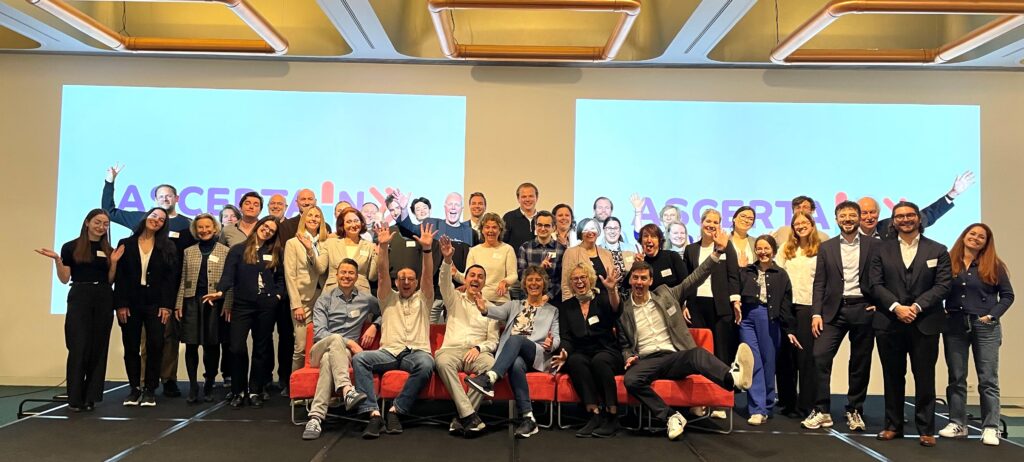
In April, the ASCERTAIN consortium gathered in Brussels for a two-day meeting marking the transition into the final phase of the project. Bringing together partners from across Europe, the meeting provided an important opportunity to reconnect, align on key priorities, and prepare for the months ahead.
The first day focused on internal collaboration, with partners working intensively on cross-model interactions, validation of the project’s three use cases, and integration of environmental impact considerations. Discussions also addressed preparations for the upcoming final conference, ensuring a strong and impactful conclusion to the project.
On the second day, ASCERTAIN welcomed a diverse group of external stakeholders, including representatives from policy, academia, and healthcare. Through interactive workshops and scenario-based exercises, participants explored how ASCERTAIN’s models and Policy Support Tool can support real-world decision-making. By testing different user perspectives, stakeholders engaged directly with the platform and provided valuable feedback on its usability, relevance, and policy application.
We now look forward to coming together again in October in Brussels for the ASCERTAIN Final Conference.
FINAL CONFERENCE IN BRUSSELS
As the ASCERTAIN project comes to an end, we are pleased to announce that our Final Conference will take place on 21 October 2026 in Brussels.
ASCERTAIN brings together patient representatives, physicians, payers, regulators, and manufacturers to improve the affordability and accessibility of innovative health technologies in Europe. Guided by a comprehensive framework integrating pricing, health technology assessment, and reimbursement, the project has developed open-access, policy-supporting tools to enhance transparency, sustainability, and fairness in health innovation.
This final event will be an opportunity to:
- Present and discuss ASCERTAIN’s key findings and policy recommendations;
- Showcase the open-access pricing, cost-effectiveness and reimbursement models and the cloud-based platform developed within the project;
- Engage with leading experts and stakeholders on the future of equitable access and sustainable pricing in Europe.
More information & registration.
NEW ASCERTAIN POSITION PAPERS: FROM EVIDENCE TO ACTION
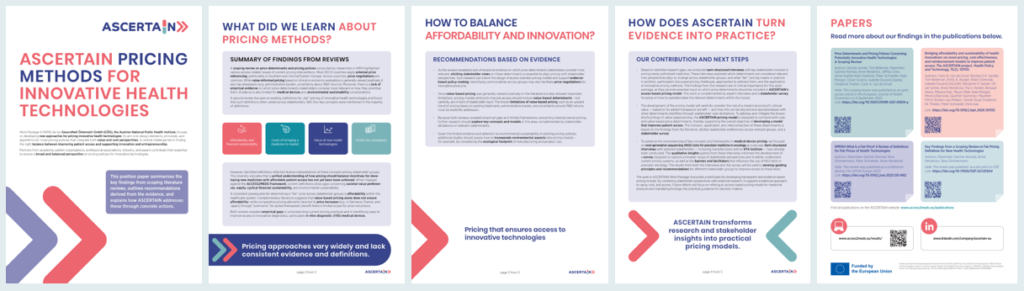
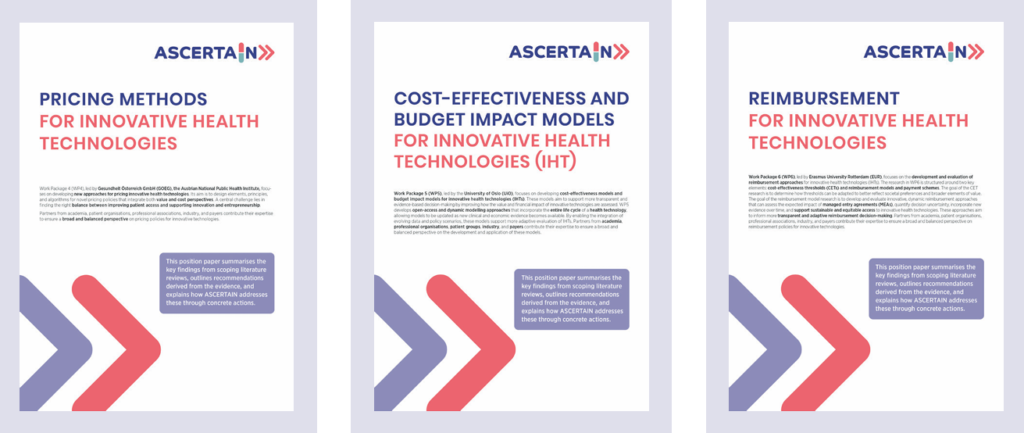
As part of our commitment to transparency and policy dialogue, ASCERTAIN has developed a series of concise position papers for Work Packages 4, 5, and 6. These documents present our work in a clear and structured format, making our findings and recommendations accessible to a broad range of stakeholders. Each paper summarises the key review results, sets out concrete evidence-based recommendations, and explains how ASCERTAIN’s tools and activities contribute to addressing the identified challenges.
Check out our three position papers:
- REIMBURSEMENT FOR INNOVATIVE HEALTH TECHNOLOGIES
- PRICING METHODS FOR INNOVATIVE HEALTH TECHNOLOGIES
- COST-EFFECTIVENESS AND BUDGET IMPACT MODELS FOR INNOVATIVE HEALTH TECHNOLOGIES (IHT)
ADVANCING ACCESS-BASED PRICING: MODEL DEVELOPMENT AND DISSEMINATION UPDATES
Work Package 4 (WP4) continues to advance the ASCERTAIN pricing work, with major progress on both the medicinal products model and the development of pricing principles for next-generation sequencing (NGS) medical devices.
A draft version of the pricing model for medicinal products was presented and discussed in eight informal online workshops with a wide range of stakeholders. These workshops included payers, industry representatives, an investor, patient advocacy experts, academics, and ASCERTAIN consortium members with expertise in health economics and HTA. Feedback focused on the model’s face validity and its potential practical use across different stakeholder contexts.
In parallel, extensive technical testing took place, including verification of output consistency; translation of the model from Microsoft Excel into R; comparisons with the AIM Fair Price Calculator and Belgian and German net prices; and stress-testing using extreme input values to identify potential errors.
Dissemination activities included a poster presentation at ISPOR Europe in November 2025 and the publication of a scoping review of fair pricing definitions as a preprint on OSF (Open Science Framework).
Finally, a stakeholder survey was prepared and disseminated to inform pricing principles for next-generation sequencing (NGS) in vitro diagnostic (IVD) medical devices in precision cancer care.
ASCERTAIN PLATFORM: FIRST PROTOTYPE AND MODEL INTEGRATION
Our focus is on developing the ASCERTAIN platform, which will serve as a central policy support tool for decision-makers. At the end of 2025, we successfully launched the first prototype. This milestone marks the beginning of an intensive phase where we collaborate closely with other work packages to integrate their models and establish the necessary interconnections.
The work is demanding, as it involves combining multiple technical components to create a scalable and user-friendly application. Our goal is to provide a robust infrastructure that can efficiently run complex health economic models while ensuring an intuitive user experience.
This process is not only technically challenging but also exciting, as it lays the foundation for sustainable use of ASCERTAIN’s results and paves the way for innovative approaches in the assessment and pricing of health technologies.
ENSURING ROBUST SECURITY ACROSS THE ASCERTAIN PLATFORM
As part of our ongoing efforts, we have completed a comprehensive security assessment of the ASCERTAIN platform and the YODA data-sharing platform used by project partners. The assessment, based on technical checklists aligned with the ISO/IEC 27002:2022 standard—an internationally recognised framework for information security controls—marks an important step in strengthening information security and data protection across the project.
Our review confirmed a strong security baseline for both platforms, including anti-malware protection, multi-factor authentication, encryption of data in transit, and a clear separation between development and production environments.
Through this process, we have verified the current security posture and identified areas for further improvement. This work helps ensure that sensitive health data exchanged within ASCERTAIN remains secure, compliant, and protected according to the highest standards.

MAKING SPECIALISED KNOWLEDGE ACCESSIBLE TO A WIDER AUDIENCE
As part of our work in ASCERTAIN, we develop educational materials for patients and the wider public. We are also preparing lay explanations of the models, framework, and online tools, which will be delivered towards the end of ASCERTAIN this year.
Developing such materials involves “translating” specialised knowledge in health economics for a wider audience with little or no background in the field. This means simplifying without losing accuracy, using different types of content and visual aids, breaking down information into small, focused sections, and demonstrating why a particular concept, approach, or evaluation matters. It is a process that involves not only summarising and translating the most relevant information but also navigating different levels of knowledge and values. For example, in our recently published Q&A document on Quality-Adjusted Life Years (QALYs), we worked to understand this health economics concept through the lens of patients’ informational needs. Academic knowledge on QALYs was therefore translated and balanced with patients’ potential interests and values.
For more information on the materials already developed please visit the “For Patients” section on our website.

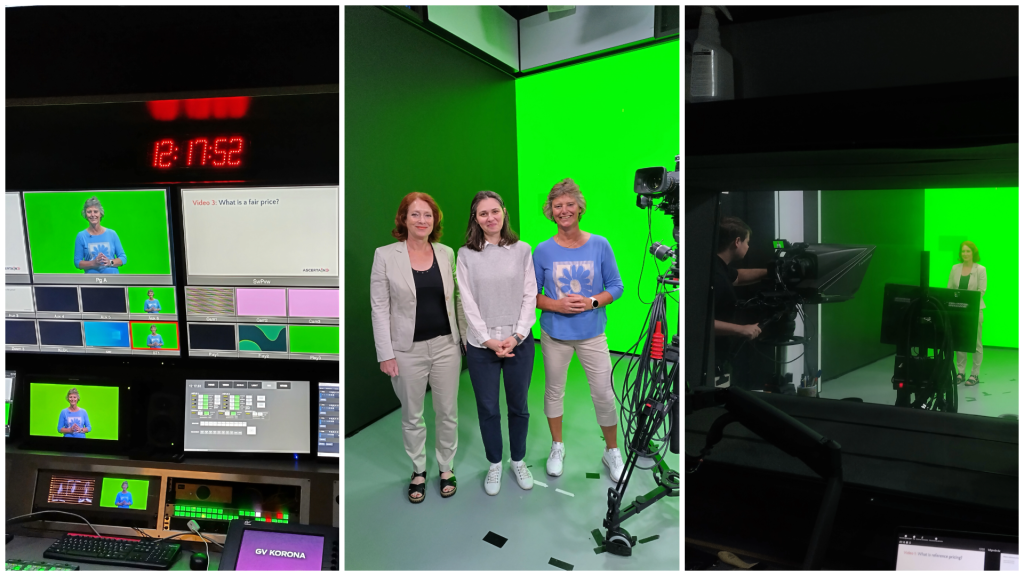
New ASCERTAIN video series explains how medicines are priced, evaluated and made available in Europe
ASCERTAIN Position Papers on Pricing, Modelling and Reimbursement Now Available

FINAL CONFERENCE
Join us for our final ASCERTAIN conference in Brussels!
21. October 2026

Don’t miss the latest updates and exciting developments in the world of innovative health technologies. Follow us on LinkedIn and YouTube to stay informed about our mission to enhance affordability and accessibility in healthcare. Join the ASCERTAIN community today and be part of the conversation for a healthier and more equitable future!