Dear readers,
Welcome to the fifth edition of the ASCERTAIN newsletter!
As ASCERTAIN progresses, our shared goal remains clear: to make healthcare innovation accessible, affordable, and evidence-based.
This edition highlights how that vision is taking shape. In our interview, Professor Tomas Tesar and Dr Mirjana Huic discuss cost-effectiveness thresholds and the challenge of balancing innovation with equity. Their insights echo ASCERTAIN’s wider mission — ensuring that value assessments reflect both scientific and societal priorities.
At the Stakeholder Day in Oslo, experts from academia, healthcare, policy, and industry came together to refine models for pricing and reimbursement, reinforcing the importance of collaboration across sectors.
Across the work packages, progress continues — from privacy and usability foundations to access-based pricing, global modelling, and preference-sensitive reimbursement approaches. Together, these efforts are building a digital platform to support transparent and flexible decision-making.
Finally, the launch of ASCERTAIN’s multilingual website demonstrates our commitment to openness and inclusion, ensuring that key findings reach stakeholders across Europe.
Enjoy reading this newsletter!
Your ASCERTAIN team



BALANCING INNOVATION AND AFFORDABILITY: PERSPECTIVES ON COST-EFFECTIVENESS THRESHOLDS


Professor Tomas Tesar, Head of the Department of Organisation and Management in Pharmacy at the Pharmaceutical Faculty of Comenius University in Slovakia. He has extensive experience in Health Technology Assessment (HTA) and has been a member of the Reimbursement Committee for Drugs at the Slovak Ministry of Health (MoH) for several years. Tomas Tesar also brings European experience; he was a member of the Executive Board of the EUnetHTA JA3 project and is now a member of the group of experts dealing with pharmaceutical preparations of the European Directorate for the Quality of Medicines in Strasbourg, France.
Mirjana Huic, MD, PhD, specialist in clinical pharmacology and toxicology from the HTA/EBM Center in Croatia, provides external HTA support to UNIBA in specific tasks within the ASCERTAIN project, as an international independent HTA expert.
How does your country decide if a new medicine is “worth the cost,” and do you think the current thresholds are fair for innovative treatments?
Tomas and Mirjana: As we already know, the growing presence of Innovative Health Technologies (IHTs), including medicines, medical devices, and procedures, poses financial challenges for existing healthcare systems, as their potentially high costs strain the limited budgets of healthcare systems and divert resources from other essential services. Many countries use economic evaluations of these IHTs to ensure the cost-effective innovation of healthcare systems. So, to ensure accessibility and affordability of IHTs, an adequate Cost-Effectiveness Threshold (CET) that represents the needs and resources of the country of interest can be essential.
In Slovakia, we have an explicit CET. From 2022, it was stated as follows:
a) 2 × Gross Domestic Product (GDP), if the difference between the gained year of life of standardized quality when using the drug under consideration and the gained year of life of standardized quality when using another medical intervention is greater than 0 and less than 0.33,
b) 3 × GDP, if the difference is 0.33 or more.
If the subject of the assessment is a drug for a rare disease or a drug for innovative treatment, the multiple of the GDP of the Slovak Republic per capita is:
a) 3 × GDP, if the difference is greater than 0 and less than 0.33,
b) 5 × GDP, if the difference is 0.33 or greater and less than 0.5,
c) 10 × GDP, if the difference is 0.5 or more.
What do you think cost-effectiveness thresholds should be based on — for example, the country’s GDP, health budget, or something else?
Tomas and Mirjana: According to the literature, there is no universal “gold standard” for implementing thresholds. Each methodological approach has specific advantages and disadvantages and must be adapted to the national context. Currently, especially in Central and Eastern European (CEE) countries, the country’s GDP per capita for one unit of health (more specifically, quality-adjusted life year – QALY) gain is the most commonly used reference point for establishing the CET.
Some countries adjust the value of the CET in specific contexts to account for unique factors or societal values. These so-called modifiers are intended to ensure that value-for-money assessments align with broader health system goals or societal preferences.
According to the results of the ASCERTAIN questionnaire related to CET, in which participants from various stakeholder groups (patients/patient representatives, HTA bodies, policymakers, healthcare providers/healthcare professionals – HCPs, payers/insurers, citizens and health technology developers) shared their opinions, more than 70% of participants think that CET is important or very important when making reimbursement decisions on innovative health technologies and should be used as a guide to interpreting cost-effectiveness. Around 44% of participants found the combination of demand-side and supply-side approaches appropriate for estimating the CET, and 41% found GDP per capita appropriate for estimating the CET.In contrast to 52% of participants who think that the CETs should be different for pharmaceuticals and medical devices, experts from the ASCERTAIN Expert Workshop agreed that CETs should be the same for all health technologies (i.e., no discrimination in CET values between pharmaceuticals and medical devices).
What problems do you see when applying these thresholds to expensive or breakthrough medicines?
Tomas and Mirjana: As we already mentioned, to ensure accessibility and affordability of IHTs, an adequate CET that represents the needs and resources of the country of interest can be essential. Multiple CET values based on different factors like relative health gain, disease severity, rarity of disease, and priority disease areas (e.g., oncology/end of life or paediatric diseases) could be the right option. For example, more severe diseases could have a higher threshold than less severe ones, and rare diseases could have a higher threshold than more common diseases. By raising the threshold considered cost-effective for treatment of more severe diseases, decision-makers can recommend more expensive treatments that provide significant benefits to patients with severe conditions. Without such modifiers, these treatments might not meet countries’ criteria for being cost-effective.
In the ASCERTAIN questionnaire related to CET, 76% of participants found modifiers important or very important when making reimbursement decisions on innovative health technologies, more specifically factors such as disease severity, rarity of disease, unmet need, equity, and uncertainty reduction. Only around 25% of participants agreed with the use of the value of knowing and the value of hope as modifiers, but the methodological problem is how to apply them. The same is true for environmental impact.
But sometimes, despite the multiple CET values, the cost the healthcare system is asked to pay is too high in relation to the benefits provided for it to be recommended for routine use. The fastest and only guaranteed way to get expensive or breakthrough medicines, medical devices, and procedures to the patients who need them is for companies to offer a fair price.
How do these thresholds influence patients’ ability to access new treatments in your healthcare system?
Tomas: It is essential to emphasize that the CET, effective from 2022, lacks scientific validity and therefore does not enhance the evidence base for pharmaceutical policy decisions in Slovakia. It negatively affects patients’ access to new treatments. The problem is further amplified by the fact that strategic pricing of innovative therapies is not based on small markets with relatively low purchasing power, such as Slovakia. However, the ASCERTAIN project can significantly influence changes in the CET, which are undoubtedly needed for Slovakia.
What changes could help patients get innovative medicines while keeping healthcare spending under control?
Tomas and Mirjana: As we know, many countries are currently in a transition period, either to establish explicit CETs or to introduce multiple CETs instead of the previous single threshold values or threshold value ranges (i.e., lower and upper threshold values).
Multiple CET values appear as a reflection of recent trends in the development of expensive innovative pharmaceuticals like targeted/personalized therapies, and many countries in transition introduce multiple CETs based on different factors like relative health gain, disease severity, rarity of disease, and priority disease areas (e.g., oncology/end of life or paediatric diseases). But according to CET experts, a balanced approach is needed when using the modifiers. If there are modifiers, the baseline CET needs to be reduced (for example, to 1 × GDP per capita, or in low-income countries, ½ × GDP per capita).In countries where economic evaluations currently do not play a formal and explicit role in reimbursement decisions, if they decide to go in this new direction, they need to discuss and make further decisions regarding the detailed methods for conducting economic evaluations, whether or not to specify a CET, which method to use, and in which way criteria beyond efficiency (new modifiers) might be considered.
In the ASCERTAIN project, to ensure accessibility and affordability of IHTs and an adequate CET that represents the needs and resources of the country of interest, we hope that we will find additional elements of value beyond the QALY and new methods to estimate CET values that account for these elements, together with an interactive, flexible, publicly available, web-based CET estimation tool.


CONSORTIUM MEETING IN OSLO
On 30 June 2025, the ASCERTAIN Consortium held its Stakeholder Day in Oslo, uniting experts from academia, healthcare, industry, and policy to explore sustainable access to Innovative Health Technologies (IHTs). The meeting focused on refining access-based pricing, cost-effectiveness, and reimbursement models by aligning them with stakeholder needs and expectations.
Opening the event, Carin Uyl-de Groot (Erasmus University Rotterdam) emphasized ASCERTAIN’s mission to create a public, cloud-based platform facilitating equitable access to IHTs — highlighting EU challenges such as system strain, unequal access, clinical uncertainty, and environmental concerns.
Maximilian Salcher-Konrad (Gesundheit Österreich) and Anne Hendrickx (AIM) unveiled a hybrid pricing model integrating cost-based (e.g., R&D, manufacturing) and value-based (e.g., clinical, societal) components, adaptable across EU contexts; treatment costs were shown to differ with disease prevalence. Stakeholder input came from EAHP (emphasizing transparent pricing tools), IKK e.V. (benchmark pricing in Germany), and EHA (highlighting the growing affordability crisis).
Eline Aas (University of Oslo) and Tom Belleman (Erasmus University Rotterdam) presented scalable cost-effectiveness models for diverse user groups and Managed Entry Agreements (MEAs) aligning payment to outcomes, respectively. Industry and public stakeholders, including AbbVie Scandinavia, NoMA, and Sykehusinnkjøp, called for modular, transparent, post-launch adaptive tools and open-source models to facilitate real-world access and procurement.
Lastly, Moritz Mumme and Pascal Wendel (OptiMedis) showcased the forthcoming ASCERTAIN Policy Support Tool. It will support full or partial assessments via guided workflows, parameter validation, and customizable sharing.
The meeting reinforced ASCERTAIN’s dedication to transparency, collaboration, and impactful tool development by inviting continued involvement through co-creation and user testing.

ASCERTAIN WEBSITE NOW AVAILABLE IN 8 LANGUAGES
This multilingual launch is an important step toward one of our core goals: making information about affordability, access, and innovation in healthcare understandable and accessible for a broad European audience. By providing translations of our content (including interviews, explanatory videos, and key concepts) we hope to reach stakeholders, patients, and decision-makers in their preferred languages.
Supporting Equal Access
The ASCERTAIN project aims to improve affordability and accessibility of innovative health technologies across Europe. This vision is reflected not only in the tools we develop but also in the way we communicate our findings.
Translating our website into several widely spoken European languages is part of this effort to ensure inclusivity and transparency. It enables more people to follow the progress of the project, understand complex health economic issues, and engage with ASCERTAIN’s work — no matter where they are based.
We’re continuously working to expand the site further. Additional languages and translated materials will be added in the future as part of our commitment to broadening engagement.
For questions or feedback on the translated versions, feel free to get in touch with our communication team.
FROM PRIVACY TO USABILITY: TECHNICAL FOUNDATIONS OF ASCERTAIN TOOLS
CHINO’s team was actively involved in the project’s data management, privacy, and ethics, continuously monitoring the data collected and updating the Data Management Plan (DMP). The team has reviewed and extended the ASCERTAIN Glossary developed under T3.2 to include privacy terms, and has also curated the ACCESS2MEDS website’s Legal Notice, Privacy Policy, and Cookie Policy.
CHINO also worked on the «ASCERTAIN_REQ_Analysis» document, which outlines the requirements for the project tool under development. The focus was on ensuring the tool’s security, compliance, and user-friendliness. The analysis covered aspects related to a smooth user experience that will require extensive testing and optimization. Security is another top priority, with the use of Hypertext Transfer Protocol Secure (HTTPS) for all data transmissions and the use of secure authentication protocols for any login functions.
From a user perspective, the tool will be highly accessible and usable, complying with WCAG 2.1 AA standards and being intuitive for all users, including those who are not technically savvy. Lastly, for data management and compliance, the tool will implement audit logs, ensure data integrity, and guarantee compliance with regulations like GDPR by using data anonymization and obtaining user consent. It has been emphasized that there is a need for 99.9% system uptime and the establishment of clear communication protocols for any planned downtime. Furthermore, regular backups and recovery procedures will be in place to protect critical data.
CROSS-MODEL INTERACTIONS AS AN INTEGRAL PART OF THE ACCESS2MEDS FRAMEWORK
Following up on our work to advance the ACCESS2MEDS Framework, we have initiated a critical phase focused on collecting and synthesizing expert input regarding cross-model interactions. This valuable input was gathered during our recent Consortium Days in Oslo, where project partners engaged in focused discussions. Specifically, we have been gathering insights to inform a definitive decision on how to best operationalize these interactions within the ACCESS2MEDS platform’s toolbox. To this end, an internal discussion forum was created to collect views and opinions from consortium members on how the respective from each model developed within ASCERTAIN can serve as an input in any of the other models. A follow-up discussion based on the obtained views will be held in October. This focused effort is essential to provide clear direction for OptiMedis within Work Package 7 (WP7) and to ensure the upcoming Framework documentation accurately reflects the most effective and integrated approach to our models. By defining these connections clearly, we will significantly enhance the framework’s internal consistency and overall utility for complex policy analysis.
ACCESS-BASED PRICING IN FOCUS: FROM LITERATURE TO STAKEHOLDER PERSPECTIVES
GOEG, AIM, and EUR have been continuing their work on developing an access-based pricing model. The focus concerned targeted literature reviews on the individual price determinants, as well as informal expert and stakeholder interviews to fill gaps not covered by the literature and to answer additional questions that came up during the reviews. These expert interviews provided us with useful information on how to operationalise the price determinants within the pricing model. Moreover, a survey was developed with the aim of eliciting stakeholder views on what price determinants are considered important, how important they are compared to other determinants, and how different kinds of value influence the price of a medicinal product. At the cut-off date, the survey had mostly been finalised and also shared with the ASCERTAIN consortium for further input, but not yet distributed to relevant stakeholders.
In addition, our draft article concerning an analysis of semi-structured interviews with stakeholders regarding relevant determinants for a newly authorised medicinal product’s price, pricing challenges, and innovative pricing approaches was discussed by a fellow researcher at the LOLAHESG Conference in Ermelo, the Netherlands, on 22–23 May 2025. This session not only provided some very useful feedback for the finalisation of the paper but was also met with interest in the project from the present audience.

DEVELOPING GLOBAL MODELS AND DEFINING END-USERS
The work in WP5 is going from developing cost-effectiveness analyses in one setting to the development of global models. In WP5, we work with developing global, open-access (cost-)effectiveness and budget impact models for the three UCs (precision cancer medicine, gene and cell therapy, and genetic profiling). These models are designed with the intention to be fully open access (including R software source with fully commented code) and able to be flexibly adapted through an interactive user interface. Individuals with either non-technical or technical skills will be able to interact with the model. Currently, we have developed models for a single setting and are now planning to expand existing models to accommodate different settings.
During the last period, we have identified two types of end-users:
- Level 1 end-users: Users that are able to adapt and parameterise the global, open-access models. Level 1 end-users will need to incorporate clinical, economic, and other input parameters, perform model validation, and inform the estimations of the cost-effectiveness and/or budget impact of an intervention and a comparator.
- Level 2 end-users: Users are different types of decision-makers that will use outputs generated by the global, open-access model. Level 2 end-users can interact with the model to vary a selected number of policy-relevant variables, e.g., price, discount rate, time horizon, exchange rate. Level 2 end-users will be dependent on completed models from Level 1 end-users.
During the consortium meeting in Oslo in July, we received input from potential end-users (from the public and private sector), providing useful reflections on the development of the global models. In the next months, we will continue the work with global, open-access models with WP7.
Furthermore, the microcosting study of genomic profiling has been newly published in the Journal of Molecular Diagnostics (Henkel et al). In addition, three cost-effectiveness analyses were presented and discussed at the Nordic Health Economics Study Group Meeting in Oslo.
UNDERSTANDING PREFERENCES ACROSS EUROPE
The work in WP6 advances the development of reimbursement processes by introducing novel cost-effectiveness threshold approaches designed to more accurately reflect societal preferences and address patient priorities. Our recent research combined qualitative and quantitative methods to better understand preferences for healthcare spending prioritisation across Europe. Building on these insights, we aim to develop flexible thresholds that can adapt to disease- and patient-specific characteristics.
This year, we initiated preparatory work for a Discrete Choice Experiment (DCE) to capture independent preferences regarding healthcare spending priorities in the form of modifiers. An initial list of 14 potential cost-effectiveness modifiers was identified through a review of existing literature. These modifiers served as potential attributes for inclusion in the DCE. To ensure the experiment’s efficiency, the number of attributes needed to be reduced. Therefore, the work began with focus groups involving 23 participants in the Netherlands, aimed at further identifying and ranking the most important attributes. This was followed by a short survey with 529 respondents from Bulgaria, the Netherlands, Norway, Slovakia, and Spain to validate and refine these rankings.
We are now in the process of finalising the preparatory phase for the DCE itself. After analysing the results from the focus groups and survey, and following a deliberate phase of internal reflection, we have defined a final set of eight factors that will be included and weighted against each other in the experiment: Severity of Disease, Rarity of Disease, Patient Age Group, Unmet Medical Need, Effectiveness of Treatment, Uncertainty of Treatment Effectiveness, Budget Impact, and Environmental Impact.
The choice experiment will be implemented across eight countries — Austria, Bulgaria, France, Lithuania, the Netherlands, Norway, Slovakia, and Spain — capturing a diverse range of regional and cultural perspectives across Europe. Members of the general public in these countries will be invited to make trade-offs between different attributes, while patient groups will be asked to complete the same experiment. These combined insights will deepen our understanding of cross-country differences in societal preferences, as well as distinctions between the views of patients and the general population. Ultimately, this work will provide a stronger evidence base to guide more transparent, inclusive, and preference-sensitive reimbursement decisions across Europe.
FROM CONCEPT TO IMPLEMENTATION: A DIGITAL PLATFORM FOR EVIDENCE-BASED DECISION-MAKING
We are currently working on the development of a web-based platform designed to support evidence-based decision-making in healthcare — for example, around pricing, cost-effectiveness assessments, and reimbursement schemes. The goal is to create an open, interactive tool that adapts to the needs of different user groups.
At this stage, our focus is on finalizing the user journeys: Together with colleagues from related work packages, we are mapping out how stakeholders such as HTA bodies, policymakers, payers, and patient organizations will interact with the platform. Based on these insights, we are defining the core requirements — both functional and technical — for the system.
This structured and user-centered approach ensures that the platform will be relevant, usable, and well integrated into real-world decision-making processes.
We aim to complete an internal prototype by July 2026. It will serve as the basis for initial testing and stakeholder feedback, leading to further development and refinement.

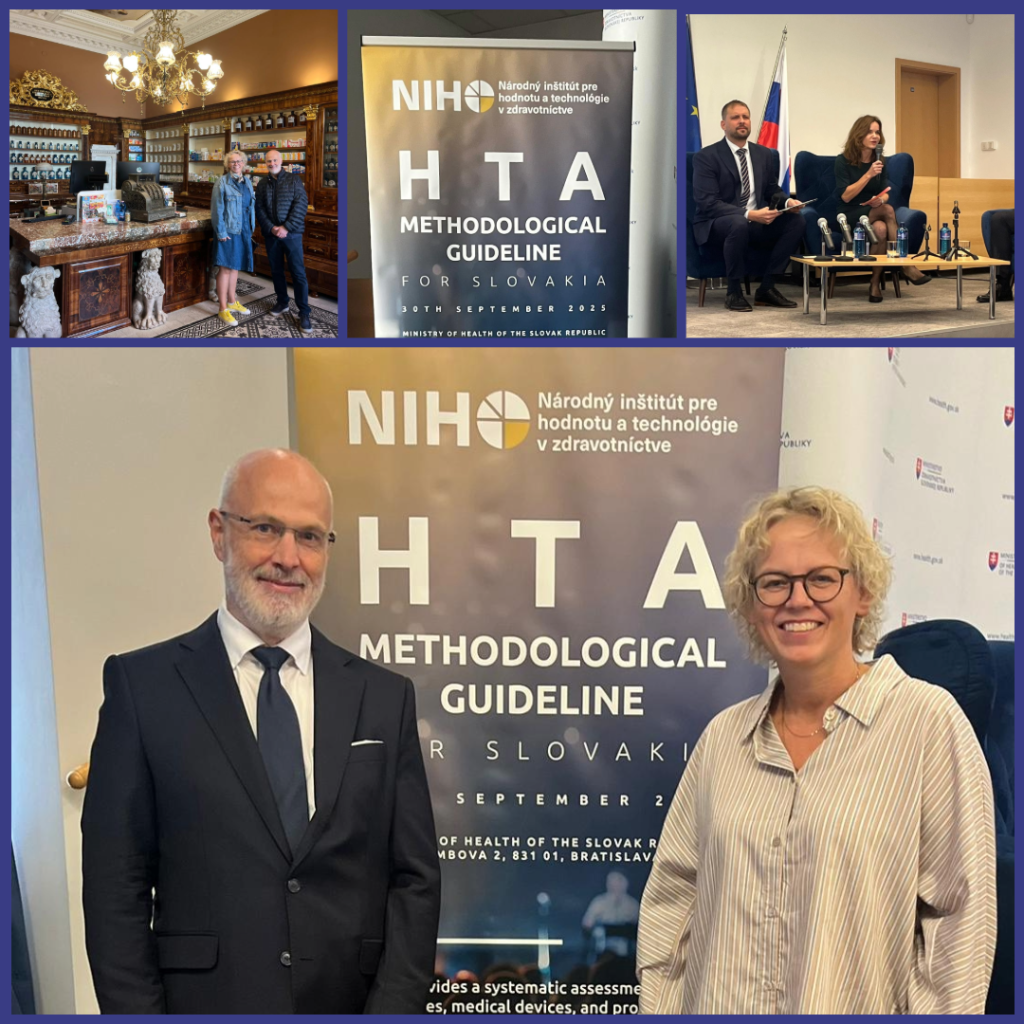
Presentation of New HTA Methodological Guideline for Slovakia at the Ministry of Health
ASCERTAIN Consortium Meeting in Oslo
ASCERTAIN Website Now Available in 8 Languages

ISPOR EUROPE 2025
Join partners from the ASCERTAIN project at ISPOR in Glasgow!
09.-12. November 2025

Don’t miss the latest updates and exciting developments in the world of innovative health technologies. Follow us on LinkedIn and YouTube to stay informed about our mission to enhance affordability and accessibility in healthcare. Join the ASCERTAIN community today and be part of the conversation for a healthier and more equitable future!